
ドイツ北部、ハンブルグ郊外にあるDeutsches Elektronen-Synchrotron (DESY)を掛谷が訪問し、
“Phase dynamics of stacked intrinsic Josephson junctions in Bi2Sr2Can-1CunO2n+4: role of the CuO2 planes composing superconducting layers“というタイトルでセミナー講演を行いました。数多くの質問をいただき、活発な議論が交わされました。
DESYでは、ハンブルグ大に所属する理論研究者とMax-Planck Instituteに所属する実験研究者が高温超伝導体における非線形・非平衡応答の研究を進めており、私たちの研究室との情報交換のための交流が実現しました。
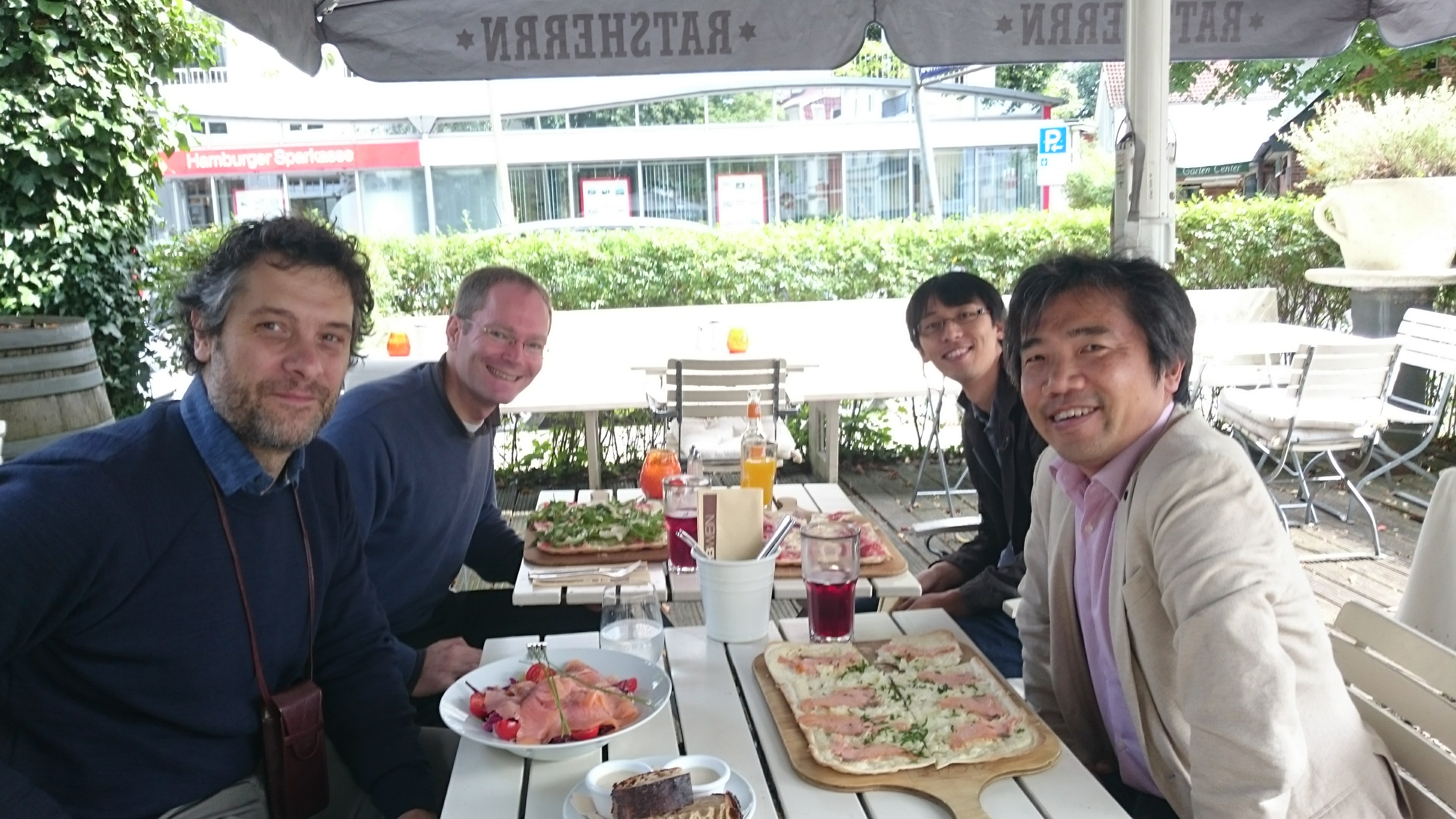
ホストは、ポスドク研究員のJunichi Okamotoさんで、実は学部が京大出身で、私たちの研究室の卒業生と某部活で同じだったとか。狭い世界です。
当地では、2日研究室に滞在し、岡本さん、Ludwig Mathey教授と議論し、実験家のAndrea Cavalleri教授とも議論し、最新鋭の時間領域分光の実験装置を見学しました。
 intrinsic Josephson junction”,
 with different maximum Josephson current density J c to reveal the doping evolution of interaction between IJJs. For the second switch, the crossover temperature between temperature-independent switching similar to quantum tunneling and thermally activated switching
  is remarkably higher than that for the first switch. Moreover,
  slightly decreases with increasing J c, which violates the conventional relation between the crossover temperature and the critical current density. These features can be explained not by a change in the Josephson coupling energy but by a change in the charging energy of the Josephson junction. We argue that the capacitive coupling model explains the increase in the fluctuation in the quantum regime of the second switch and the anti-correlation between
  and J c. Furthermore, inductive coupling does not contribute to these peculiar phenomena in the switching dynamics of stacked IJJs.